
APA102 vs APA107 vs HD107S vs SK9822: Choosing the Right Clocked LED Chip for Your Project
In the world of addressable LED strips, most people are familiar with single-wire protocols like WS2812B. However, for applications requiring higher refresh rates, faster data transmission, and more reliable control, clocked (dual-wire) LED chips are the superior choice.
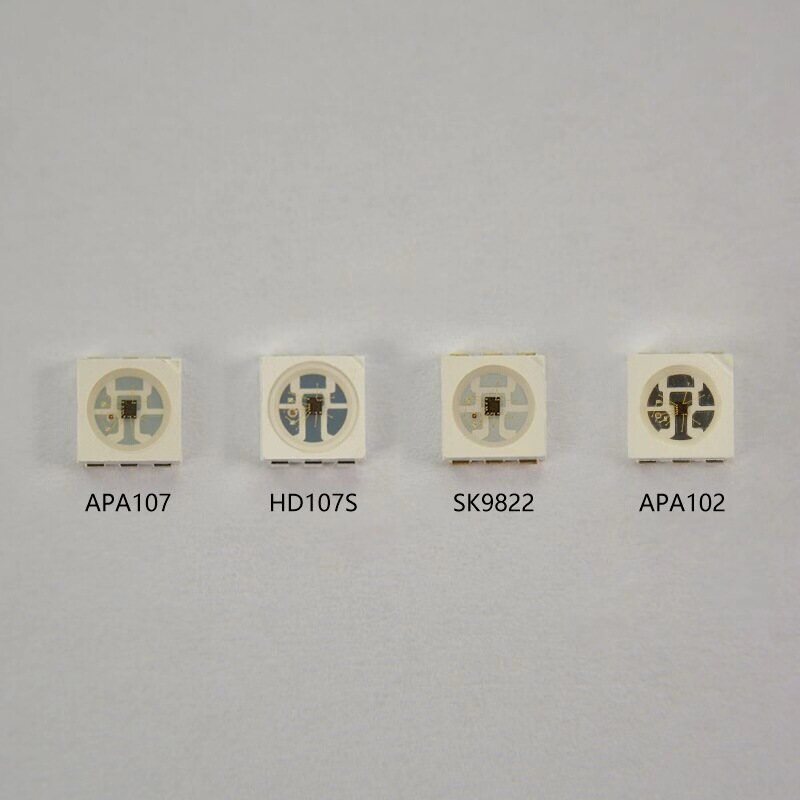
Four popular options in this category are the APA102, APA107, HD107S, and SK9822. While they are all compatible with the same basic protocol, their performance characteristics differ significantly.
This article compares these four chips to help you select the right one for your project — whether you are building a high-end video wall, a camera-friendly display, or a cost-effective decorative installation.
Quick Overview

Note: All four chips operate at DC5V and use an 8-bit (256-level) grayscale per channel (RGB). They also feature a 5-bit global brightness control (32 levels) for additional dimming without losing color resolution.
What Makes Clocked LEDs Different?
Unlike single-wire LEDs (e.g., WS2812B) that combine data and timing into one signal, clocked LEDs use two separate lines: Data (SDI) and Clock (CKI).

The key advantage: Because the clock line drives the timing, you don't need to worry about generating precise microsecond-level delays. This makes clocked LEDs much easier to work with on platforms like Raspberry Pi, Arduino (using SPI), or any microcontroller with a clock output.
Detailed Chip Comparison
1. SK9822 – The Budget-Friendly Option
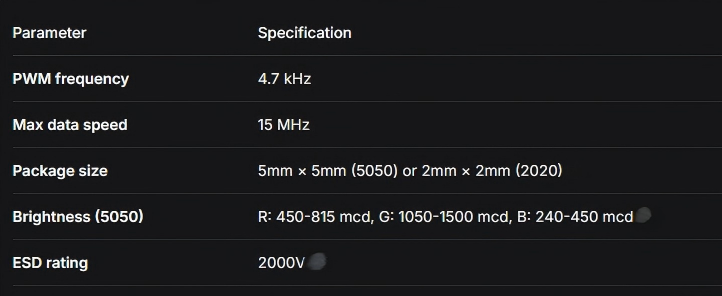
The SK9822 is often regarded as a cost-effective clone of the APA102. It gets the job done but with the lowest performance of the group.
Pros:
Most affordable option
Compatible with APA102 protocol
Good enough for basic color-changing effects
Cons:
Lowest PWM rate (may show flicker in video)
Lower data speed limits cascade length for high-refresh applications
Best for: Budget-conscious projects, basic decorative lighting, applications where cameras are not involved.
2. APA107 – The Balanced Mid-Range Choice
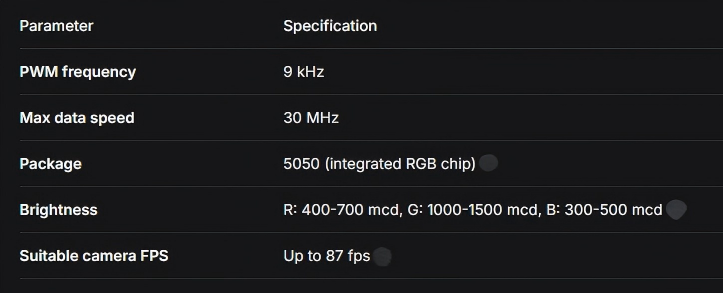
The APA107 is produced by Newstar LED and offers a significant step up from the SK9822 while remaining affordable.
Pros:
Good balance of performance and price
9 kHz PWM reduces visible flicker
Faster data speed than SK9822
Cons:
Not as fast as HD107S
Original APA107 may be harder to find (upgraded to HD107S)
Best for: General LED strip projects, museum displays, retail signage, and applications where some video recording is expected.
3. APA102 – The Original Standard
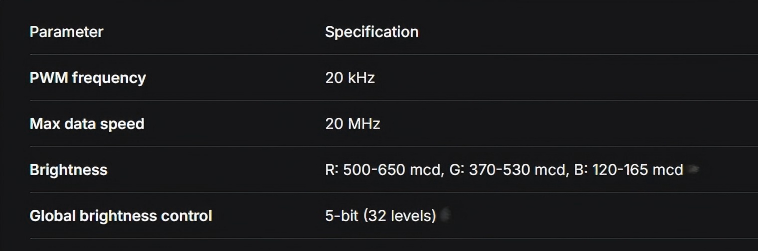
The APA102 was the chip that popularized clocked addressable LEDs. However, note that original APA102 chips are no longer in production — what is available today are clones like APA102C, which may have lower performance.
Pros:
Good PWM rate (20 kHz)
Widely supported by software libraries
Solid performance for most applications
Cons:
Original version discontinued; clones may underperform
Lower data speed than HD107S
Slightly higher cost than SK9822
Best for: Legacy projects, applications where APA102 is specifically required, general-purpose addressable lighting.
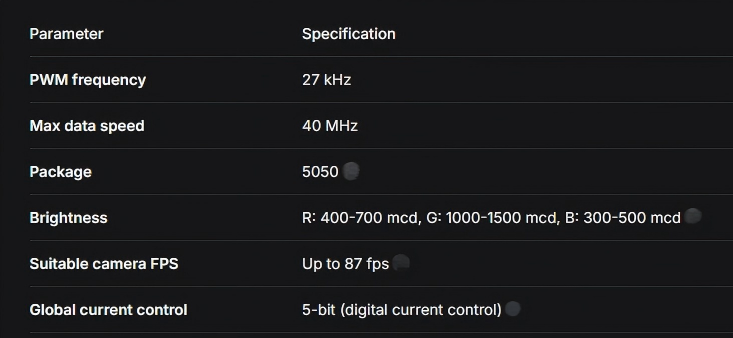
4. HD107S – The High-Performance Leader
The HD107S is the direct upgrade and replacement for both APA102 and APA107. Produced by Hida using Newstar's NS107S IC, it offers the best performance in this comparison.
Pros:
Highest PWM rate (27 kHz) — no flicker in video
Fastest data speed (40 MHz) — supports longer cascades
Digital current control allows brightness adjustment without losing grayscale resolution
Fully compatible with APA102 protocol
Cons:
Most expensive option
Overkill for simple decorative lighting
Best for: Professional video productions, high-speed photography, large LED matrices, broadcast studios, and high-end commercial displays.
Key Technical Differences
PWM Frequency and Camera Flicker
The PWM (Pulse Width Modulation) frequency determines how fast the LED turns on and off to create dimming. Higher PWM rates are less likely to cause visible flicker when recorded by cameras.

For any application where the LEDs will be filmed — such as music videos, live-streamed events, or televised productions — HD107S is the safest choice.
Data Speed and Cascade Length
Higher data speeds allow you to update more LEDs per second, which is critical for smooth animations on long strips or large matrices.

Calculation note: Each LED requires 32 bits of data per frame (32 clocks). At 60 frames per second, the formula is:
(Data Speed / 32 bits) / 60 fps = maximum LEDs.
Global Brightness Control
All four chips feature a 5-bit global brightness register (32 levels) that sits before the 8-bit-per-channel PWM control. This is a unique advantage over single-wire chips:

This allows you to dim the entire strip smoothly without losing the subtlety of color gradients — a common problem with single-wire LEDs where dimming reduces effective bit depth.
Compatibility and Drop-In Replacement
Important: All four chips are protocol-compatible with each other. In most cases, you can:
Replace APA102 with HD107S without changing code
Use APA107 as a drop-in for APA102
Mix SK9822 with APA102 (though performance will default to the lowest common denominator)
When programming, you can typically select "APA102" as the LED type in software libraries, and it will work with all four chips.
Which Chip Should You Choose?

Summary Table

Final Thoughts
The clocked LED chip family (APA102, APA107, SK9822, HD107S) offers significant advantages over single-wire alternatives: faster refresh rates, flicker-free video, easier microcontroller integration, and global brightness control.
For most new projects, HD107S is the best choice — it delivers the highest performance and is fully compatible with APA102 code. If budget is a primary concern, SK9822 provides a workable entry point. For a balance of cost and capability, APA107 hits the sweet spot.
Looking for Clocked LED Strips for Your Project?
We offer addressable LED strips based on all four chips — SK9822, APA107, APA102, and HD107S — in various densities (30, 60, 144 LEDs/m) and waterproof ratings.
👉 Contact Us Today to discuss your project requirements.