
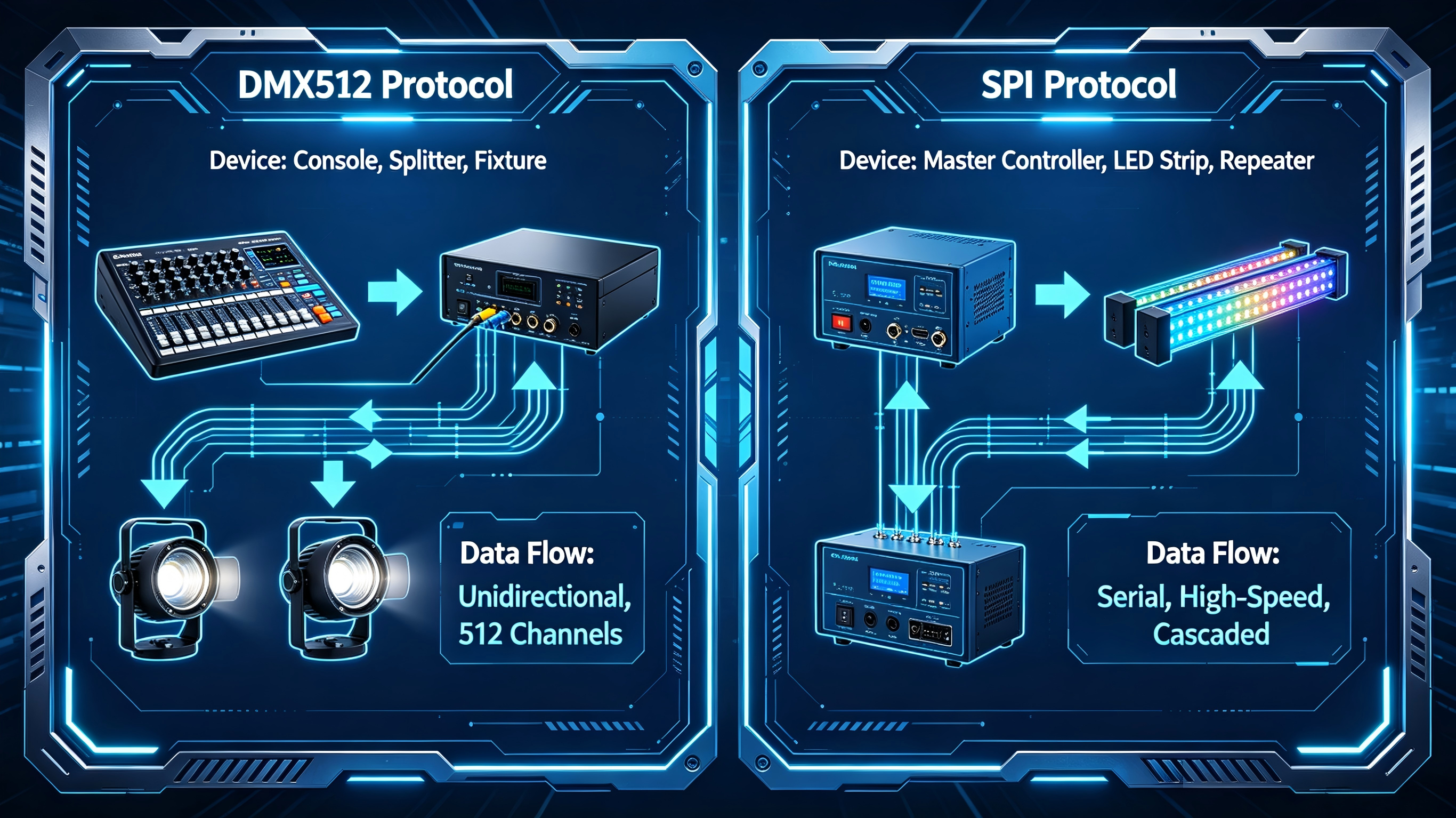
Understanding DMX512 vs SPI Control for Addressable LED Lights
When it comes to addressable LED lighting, choosing the right control protocol is one of the most important decisions you'll make. Two of the most common options are DMX512 and SPI. While both allow you to control individual LEDs, they work very differently—and each has its own strengths.
Let's break down the differences in plain English, so you can decide which one is right for your project.
What Is DMX512?
DMX512 (Digital Multiplex) is a professional lighting control protocol that has been the industry standard for stage, architectural, and entertainment lighting for decades.
How it works:
- DMX uses a daisy-chain topology (one fixture to the next)
- Each fixture is assigned a starting address
- Data is sent at 250 kbps
- Standard DMX universes support up to 512 channels
Typical applications:
- Theater and stage lighting
- Architectural building facades
- Large-scale permanent installations
- TV and film studios
What Is SPI?
SPI (Serial Peripheral Interface) is a communication protocol commonly used in addressable LED strips like WS2812B, SK6812, and APA102C.
How it works:
- Data is sent serially from one LED to the next
- Each LED chip has a built-in IC that reads and forwards data
- Runs at various speeds (typically 800 kbps for WS2812B, up to 20+ MHz for APA102C)
- No concept of "universes" — the data stream simply continues
Typical applications:
- DIY and hobbyist projects
- Music-reactive LED displays
- Holiday light shows
- Small to medium commercial installations
Key Differences at a Glance:

When to Choose DMX512
Choose DMX512 if:
- You need a proven, reliable protocol for a permanent installation
- Your project spans long distances (building facade, outdoor landscape)
- You require standardized equipment that works across brands
- You need RDM (Remote Device Management) for remote configuration
- Your project is theater, TV, or large-scale architectural
Example: A 500-meter building outline with hundreds of pixel nodes, controlled by a professional lighting console.
When to Choose SPI
Choose SPI if:
- You're working on a DIY or hobbyist project
- Your installation is small to medium (under 10 meters from controller to first LED)
- Cost is a primary concern
- You want simple, affordable controllers (Arduino, Raspberry Pi, SP107E, etc.)
- You need very fast refresh rates (video mapping, high-speed animations)
Example: A custom LED sign for a small retail store, controlled by a $20 SPI controller.
Can You Use Both?
Yes. Many professional installations use SPI-to-DMX converters or DMX-controlled SPI drivers. This gives you the best of both worlds: the widespread compatibility and long-distance reliability of DMX, combined with the low cost and high density of SPI LED strips.
At Xuanan Lighting, we offer both DMX512 and SPI options across our product lines. We can also help you design a hybrid solution that fits your specific project requirements.
Quick Selection Guide:

Final Thoughts
There's no "right" or "wrong" choice—only what's right for your specific project. SPI is affordable, fast, and easy to use for smaller installations. DMX512 is the professional standard for large-scale, long-distance, mission-critical applications.
Still not sure which protocol is right for you?
Our team at Xuanan Lighting can help you evaluate your project requirements and recommend the best solution. We offer both DMX512 and SPI products, and we're happy to answer any technical questions you have.
Contact Us Today to discuss your addressable LED project.