
GS8206 vs GS8208: Choosing the Right Constant Current LED Driver for Your Project
When designing addressable LED lighting systems — such as pixel strips, modules, or signage — the choice of driver IC directly impacts performance, power efficiency, and reliability.
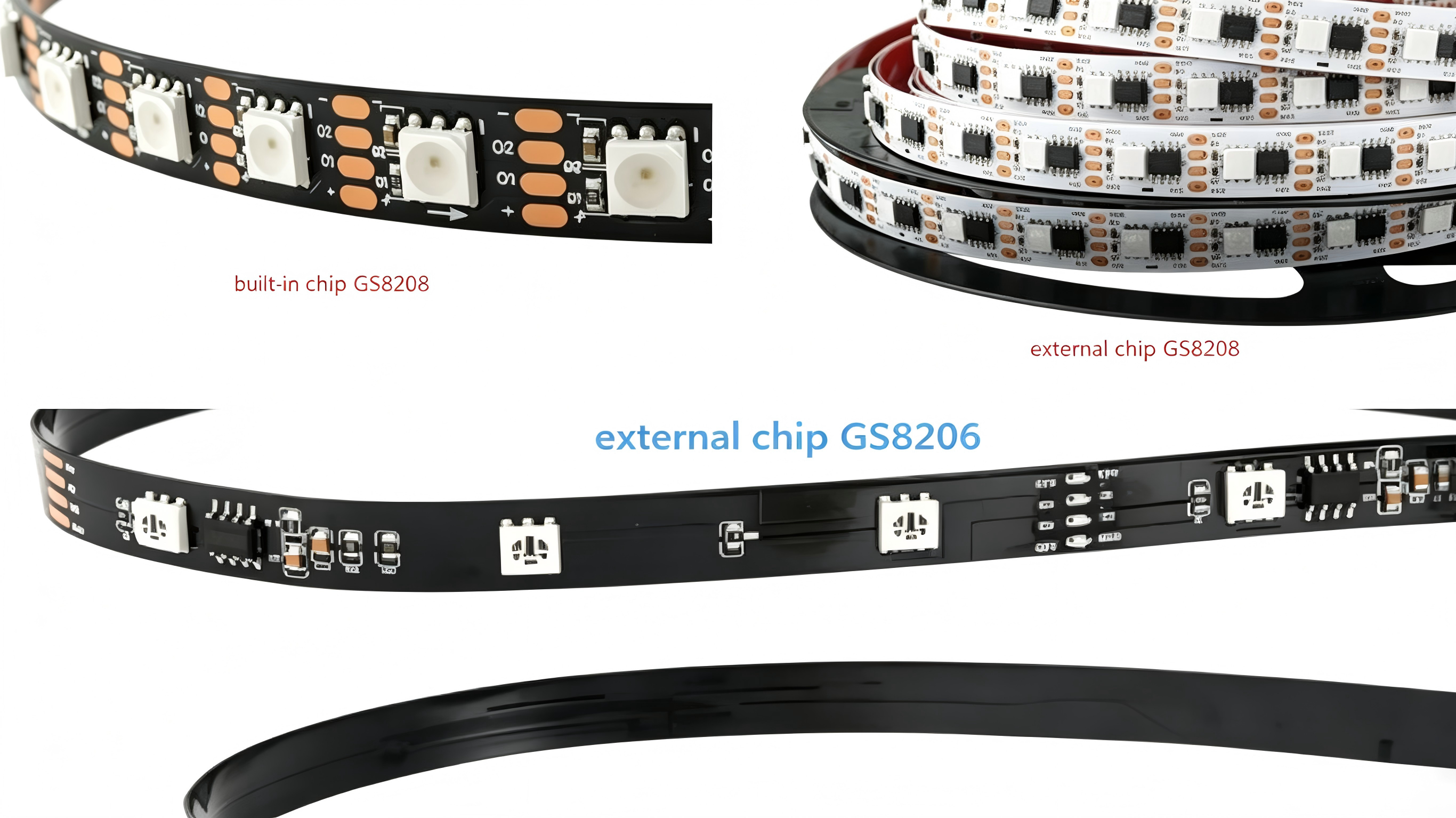
Two popular options from Genesis Technology are the GS8206 and GS8208. While they share many similarities (dual-channel redundancy, built-in display patterns, 8-bit data with 12-bit GAMMA correction), their operating voltages and output architectures differ significantly.
This article compares these two ICs to help you select the right one for your application.
Quick Overview
Feature | GS8206 | GS8208 |
|---|---|---|
Supply voltage (VDH) | 5V – 24V | 9V – 15V (12V typical) |
Output architecture | Parallel | Series |
Default output current | 17mA | 17.5mA |
Minimum output current | 11mA | 11mA |
Output port withstand voltage | 24V | 15V |
PWM refresh rate | 8kHz | 8kHz |
Data protocol | e-RZ (800kHz) | e-RZ (800kHz) |
Dual-channel redundancy | Yes (SDI + SDI2) | Yes (SDI + SDI2) |
Built-in display patterns | Yes (6 categories, 32 series) | Yes (6 categories, 32 series) |
Automatic test mode | Yes (power-on) | Yes (power-on) |
GAMMA correction | 12-bit built-in | 12-bit built-in |
Package | SOP8 | SOP8 |
Operating temperature | -40°C to +85°C | -40°C to +85°C |
ESD rating | 2kV (HBM) | 2kV (HBM) |
Key Difference 1: Operating Voltage Range

GS8206 offers wider voltage compatibility — from 5V logic systems up to 24V high-voltage runs. This makes it suitable for a broader range of applications.
GS8208 is specifically optimized for 12V systems, with tighter voltage requirements but better efficiency within that range.
Key Difference 2: Output Architecture – Parallel vs Series
This is the most important technical difference between the two ICs.

Why this matters:
GS8206 (Parallel architecture):
Each output channel drives its own LED independently
Higher total current consumption (3 channels × 17mA = 51mA per IC)
Better suited for 5V or low-voltage applications
Simpler PCB layout
GS8208 (Series architecture):
LEDs are connected in series strings
Same current flows through all LEDs in the string
Total current is only 17.5mA (1/3 of GS8206's total)
Significantly lower power consumption for the same number of LEDs
Requires higher voltage (12V typical) to drive series strings
Practical implication: For a 12V system with multiple LEDs per channel, GS8208's series architecture is more power-efficient, reducing overall system current draw and heat generation.
Key Difference 3: Output Port Withstand Voltage

GS8206 can handle higher output voltages (up to 24V), making it suitable for systems with longer LED strings or higher voltage requirements. GS8208 is limited to 15V, which is sufficient for 12V systems but not for 24V applications.
Common Features (Both ICs)
Both chips share several advanced features that make them attractive for professional LED lighting designs:
Dual-Channel Redundant Control
Both GS8206 and GS8208 feature two data input pins (SDI and SDI2) for redundant signal transmission.

Built-in Display Patterns (No Controller Needed)
When no external signal is received, both ICs automatically enter internal display pattern mode:

Benefit: These patterns make the ICs suitable for applications where a controller is not available or desired — the LEDs run automatically after power-on.
Power-On Automatic Test
After power-on, both ICs enter test mode, displaying red, green, and blue sequences — useful for production testing and debugging.
MPWM Technology – 8kHz Refresh Rate
Both chips use MPWM (Multi-PWM) technology, achieving an 8kHz PWM refresh rate — significantly higher than many competitor ICs (typically 400Hz – 2kHz).

Staggered Output Delay
To prevent power interference and voltage fluctuations, both ICs have built-in output staggering — OUT1, OUT2, and OUT3 activate at 80ns intervals.

Electrical Characteristics Comparison

Application Recommendations

Summary Table

Final Thoughts
Both GS8206 and GS8208 are high-performance constant current LED drivers with advanced features like dual-channel redundancy, built-in display patterns, and 8kHz PWM refresh.
Choose GS8206 if:
Your system uses 5V, 12V, or 24V (mixed or uncertain voltage)
You need higher output voltage tolerance (up to 24V)
You prefer simple parallel architecture
Choose GS8208 if:
Your system is strictly 12V
Power efficiency is a top priority (series architecture uses 1/3 the current)
You want to minimize heat generation
Looking for LED Drivers for Your Project?
We offer LED strips, modules, and custom solutions based on GS8206, GS8208, and other popular ICs. Tell us your requirements, and we will recommend the right solution.
👉 Contact Us Today to discuss your project.