
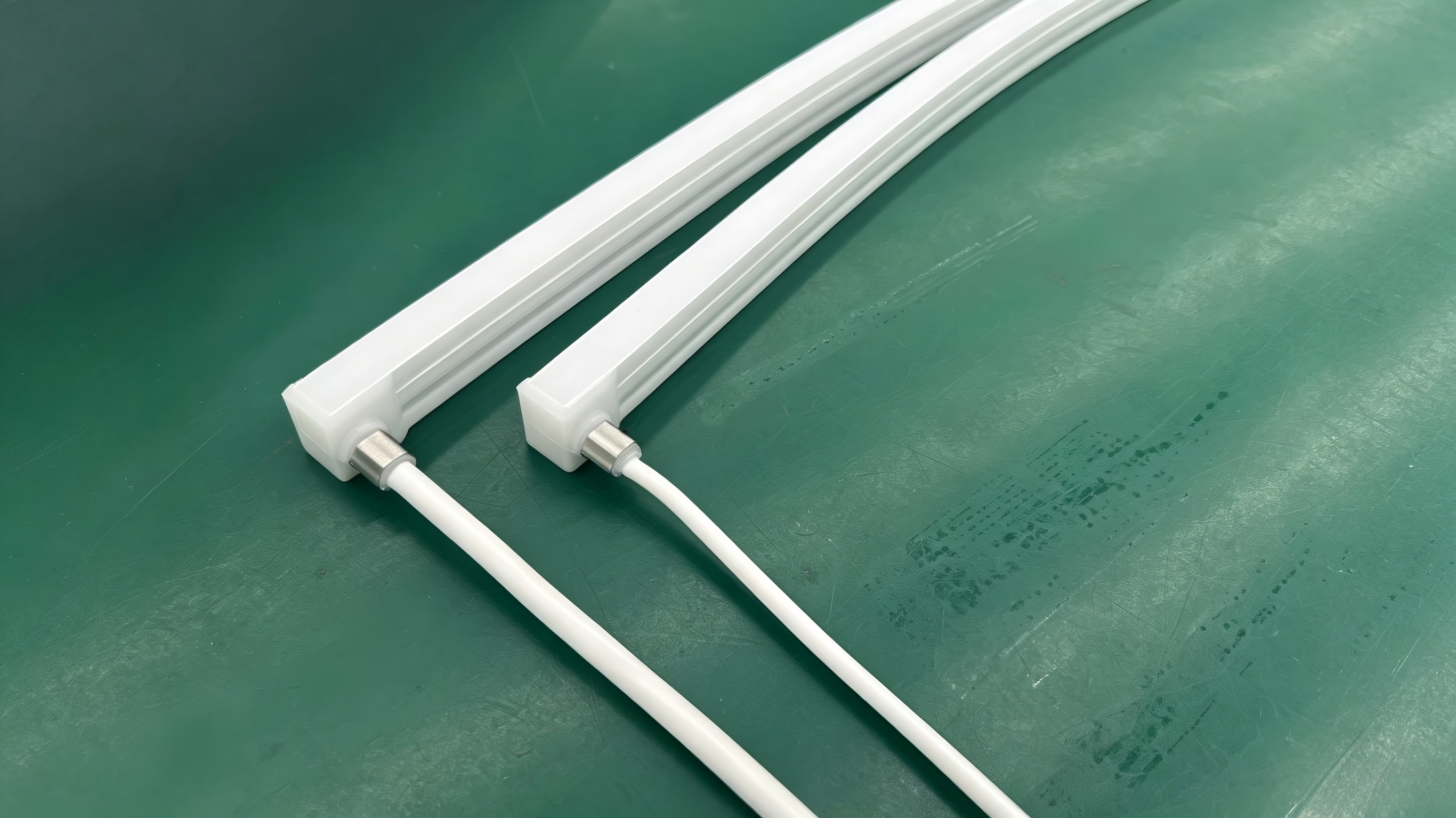
One-Piece Extrusion vs Two-Piece Extrusion: Understanding IP68 Neon LED Strip Manufacturing
When sourcing IP68 waterproof neon LED strips for outdoor or underwater applications, you may encounter two different manufacturing processes: one-piece extrusion and two-piece extrusion (also known as secondary extrusion).
Both can achieve IP68 waterproof ratings. However, their construction, durability, and light output differ significantly.
This article explains the technical differences between these two extrusion methods — so you can make an informed decision for your project.
What Is Extrusion in LED Manufacturing?
Extrusion is a manufacturing process where softened silicone or PVC material is forced through a die to create a continuous profile — much like squeezing toothpaste out of a tube or making pasta.
For neon LED strips, extrusion creates the silicone casing that houses the LED board. The extrusion method determines:
How well the casing seals against water
How uniform the light appears
How durable the strip is over time
One-Piece Extrusion
In one-piece extrusion, the silicone casing is formed around the LED board in a single pass through the extrusion die. The LED board and the silicone become a single, integrated unit.

Manufacturing steps:
LED board is prepared (soldered, tested)
Board is fed into an extrusion machine with liquid silicone
Silicone is molded around the board in one continuous pass
The strip is cured and cut to length
Key characteristics:
Fully integrated — casing and LED board are inseparable
No glue or secondary sealing required
Simpler manufacturing process
Two-Piece Extrusion
In two-piece extrusion (also called secondary extrusion), the silicone casing is produced in two separate steps. Typically, an inner diffusion layer is extruded first, followed by an outer protective layer.

Manufacturing steps:
Inner silicone tube (with light-diffusing properties) is extruded
LED board is inserted into the inner tube
Outer protective silicone layer is extruded over the assembly
The strip is cured and cut to length
Key characteristics:
Two-layer construction (diffusion layer + protection layer)
Can achieve better optical performance
More complex manufacturing process
Key Differences at a Glance

Technical Deep Dive: Why Two-Layer Construction Improves Light Diffusion
The primary advantage of two-piece extrusion is optical performance.
In a one-piece extrusion, light diffusion depends entirely on the silicone material's natural scattering properties. While adequate for most applications, some "hotspots" or slight color variations may still be visible at close range.
In a two-piece extrusion:
The inner layer is formulated specifically for light diffusion (often with microscopic scattering particles)
The outer layer provides mechanical protection and UV resistance
The interface between layers can further scatter light, creating a more uniform glow
Result: Two-piece extrusion typically produces a smoother, more consistent light line — with no visible LED dots or color banding — even when viewed up close.
Waterproofing Comparison
Both methods can achieve IP68 (continuous submersion) ratings. However, the failure modes differ.
Failure Mode | One-Piece Extrusion | Two-Piece Extrusion |
|---|---|---|
Water ingress at cut ends | Same risk (must seal cut ends) | Same risk (must seal cut ends) |
Water ingress through casing | Extremely low (monolithic) | Very low (two barriers, but interlayer wicking possible) |
Water ingress at aging cracks | Low (crack penetrates entire wall) | Lower (crack may only affect outer layer) |
Note: Both methods require proper end-capping and sealing of cut ends. The extrusion method affects the casing, not the end seals.
Which One Should You Choose?
If your priority is... | Recommended extrusion type |
|---|---|
Absolute waterproof reliability for deep submersion | One-piece extrusion (simpler, fewer potential failure points) |
Best possible light uniformity for visible installations | Two-piece extrusion (superior diffusion) |
Cost-effectiveness for general outdoor use | One-piece extrusion |
High-end architectural or retail displays | Two-piece extrusion |
Flexibility for complex curved installations | Two-piece extrusion (layers can move independently) |
How to Identify the Extrusion Type
When evaluating neon LED strips, ask your supplier these questions:
Question | Why It Matters |
|---|---|
"Is this one-piece or two-piece extrusion?" | Confirms the manufacturing process |
"Can I see a cross-section of the strip?" | Visually verify layer count |
"What is the typical light uniformity (any visible hotspots at 10cm distance)?" | Performance indicator |
Visual inspection: If you can see two distinct layers when looking at a cut end (a clear inner tube and an outer jacket), it is two-piece extrusion. If the silicone appears uniform throughout, it is one-piece extrusion.
Summary
Extrusion Type | Core Advantage | Trade-off |
|---|---|---|
One-Piece | Simpler, fewer failure points, typically lower cost | Light diffusion is good but not premium |
Two-Piece | Superior light uniformity, better flexibility | Higher cost, more complex construction |
Both extrusion methods produce high-quality IP68 neon LED strips. The right choice depends on your project's balance between optical performance and cost.
For critical visual applications where the light strip will be seen up close (e.g., retail displays, architectural accents), two-piece extrusion is worth the premium. For general outdoor or underwater applications where absolute waterproofing is the priority (e.g., pool perimeter, fountain lighting), one-piece extrusion is an excellent choice.
Have a Technical Question About Neon LED Strips?
Understanding extrusion methods helps you specify the right product for your project. If you are unsure which type suits your application, we can help.
👉 Contact Us Today to discuss your neon LED strip requirements.