
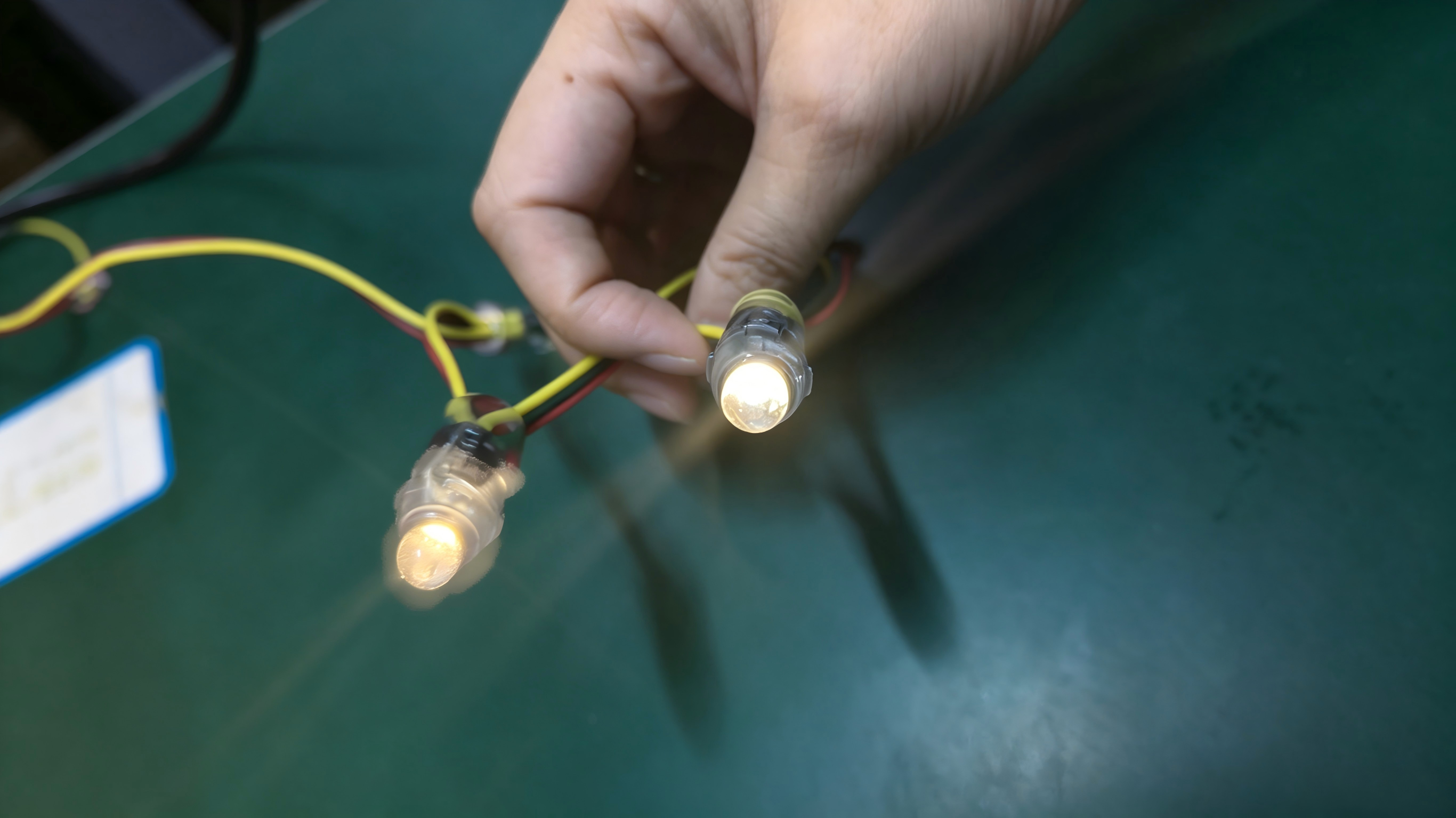
Sometimes a Sample Speaks Louder Than Words: Teaching What "Single White LED + IC" Really Means
In this industry, we talk a lot about specifications: voltage, pixel pitch, IC type, lumen output. But sometimes, the best way to explain a product concept is to show it — physically, visually, and in action.
Recently, I had one of those moments with my client Alvaro.
The Challenge: Explaining a Concept That's Hard to Visualize
Alvaro needed to understand a specific product configuration: a 12mm exposed LED string light with a single white LED and an integrated circuit (IC).
On paper, this sounds simple. But in practice, many people assume that an "addressable" or "IC‑controlled" LED must be RGB. They ask:
"If it has an IC, why is it only white? Can it change colors?"
This is where words fail — and a sample succeeds.
Our Solution: A Free 10‑Light Warm White Sample String
To help Alvaro truly understand the product, we decided to make a free sample string — 10 warm white LEDs with integrated ICs, built exactly to the specification we discussed.
What we sent:
10pcs 12mm exposed LEDs
Single white LED per pixel (warm white)
Built‑in IC (addressable)
Compatible with SP105E controller
The Test: Connecting to an SP105E Controller
We connected the sample string to a standard SP105E controller — a popular Bluetooth LED controller that supports RGB addressable strips.
Then we ran a simple test: select different colors on the controller.
Controller Command | What Happened |
|---|---|
Select "Red" | The string showed warm white (as expected) |
Select "Green" | The string showed warm white |
Select "Blue" | The string showed warm white |
Select "Color Chasing" | The string showed chasing warm white |
Select "Jumping" | The string showed jumping warm white |
Select "Running" | The string showed running warm white |
Select "Fading / Strobe" | The string showed fading / strobing warm white |
The result? Regardless of which color we selected on the controller, the LEDs always emitted warm white light — but they followed all the dynamic effects: chasing, jumping, running, fading, and strobe.
This is the essence of a single‑color addressable LED — you get full dynamic control (animation, speed, patterns), but the color remains fixed.
Why This Confusion Exists
Many people in the lighting industry are familiar with RGB addressable LEDs (e.g., WS2812B, SK6812, UCS1903), where each pixel can display any color.
But single‑color addressable LEDs are less common. They are often used for:
Warm white chasing effects on building outlines
Cool white running lights for signage
Amber animations for festive or wayfinding applications
The concept is simple: IC controls the timing and sequence, but the LED chip itself is single‑color.
However, without seeing it in action, the concept can be confusing — hence the sample.
What This Taught Me About Client Education
I've learned that in B2B lighting sales, explaining is not the same as showing.
A datasheet can say "single white LED with IC." A call can describe how it works. But a video of the actual sample running through different effects — that's what truly makes the concept click.
"Oral explanation is far less effective than a clear video in helping someone understand."
I am always happy to do this kind of seemingly "unprofitable" work for my clients — because it builds trust, eliminates confusion, and ensures that what we deliver is exactly what the customer expects.
Key Takeaways for Buyers & Specifiers
If you are considering... | What you need to know |
|---|---|
Single‑color addressable LEDs | They support chasing, jumping, running, fading, and strobe — just not color changing. |
Controller compatibility | Most RGB controllers (like SP105E) will work — the IC responds to animation commands, not color data. |
Best applications | Architectural outlining, monochrome chasing effects, warm white holiday displays, wayfinding sequences. |
Testing before ordering | Ask your supplier for a small sample string — it is the fastest way to confirm understanding. |
Final Thoughts
Not every inquiry leads to an immediate large order. Sometimes, it leads to a conversation, a question, and — if you are lucky — a chance to truly help a client understand something new.
That is what happened with Alvaro. And I am glad we made that free sample.
Because in the end, a well‑informed customer is a long‑term partner.
Do You Need a Sample to Understand a Concept?
If you are unsure about a product specification — whether it is single‑color addressable LEDs, pixel pitch options, or IC behavior — ask for a small sample. We are happy to help, even if it is not a "profitable" order upfront.
👉 Contact Us to discuss your project or request a test sample.